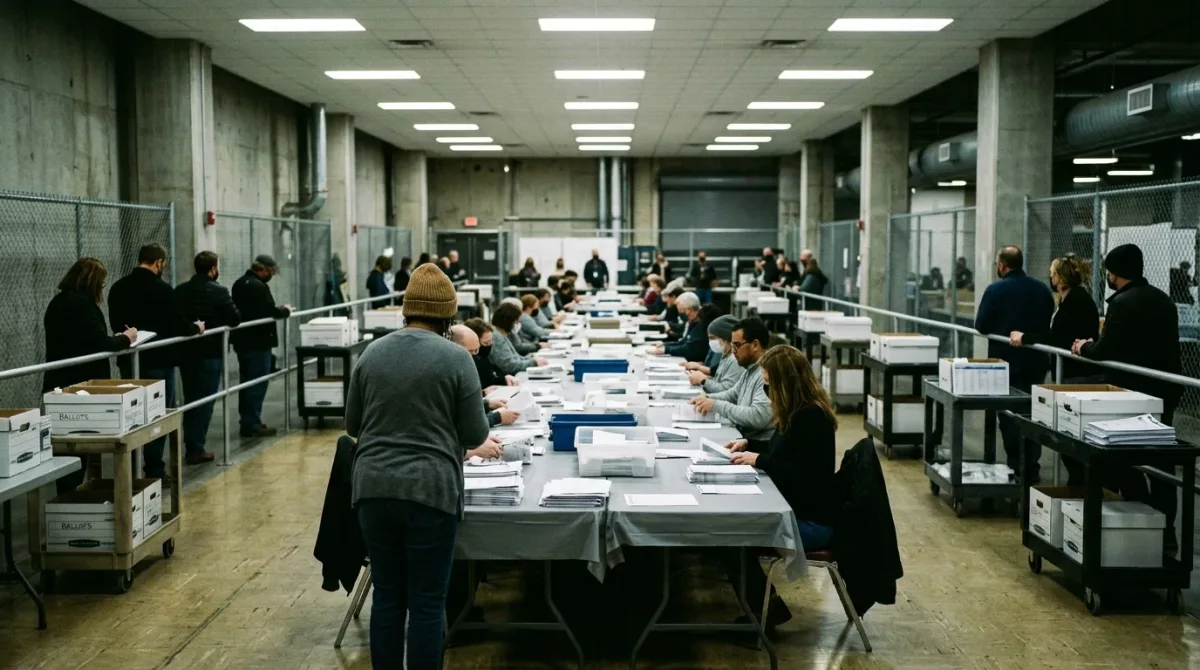
A margin of half a percentage point or less triggers a state-paid, mandatory recount in seven states, while eleven others use a fixed vote-count cutoff instead of a percentage, according to state-by-state statutes compiled by NBC News and The Hill (SRC-01, SRC-02). No federal law sets a uniform recount trigger; each state legislature writes its own threshold, timeline and cost rules, so a race decided by the same raw vote margin can be automatically recounted in Pennsylvania and left uncounted a second time in New Jersey.
What Triggers an Automatic Recount?
An automatic recount is a recount state law requires without either candidate filing a request, once the certified margin between the top two finishers falls inside a preset threshold. Twenty-six states plus the District of Columbia have such a provision on the books; the remaining states and territories leave recounts to a candidate’s request and, in most cases, a bond or fee that candidate must post (SRC-01). The threshold is applied after county-level canvassing produces unofficial totals but typically before final statewide certification, so the recount becomes part of the certification timeline rather than a challenge to a result already locked in.
The specific trigger takes one of two forms. A percentage-margin threshold measures the gap between the top two candidates as a share of total votes cast for the office. A fixed vote-count threshold instead sets a flat number of ballots separating the candidates, regardless of how large the overall electorate is. Some states, including Washington, combine both tests and require the margin to clear each one before a recount is waived (SRC-01).
Which States Set the Tightest Margins?
Seven states trigger an automatic recount at a margin of 0.5 percentage points or less: Alabama, Arizona, Colorado, Florida, Kentucky, North Dakota and Pennsylvania, per the state statute summary reported by NBC News (SRC-02). New Mexico and Ohio set the bar even tighter, at 0.25 percent or less. A separate group of states, including Alaska, Montana, South Dakota, Texas, Utah and Vermont, reserves the automatic recount for races that end in an exact tie rather than any narrow-but-nonzero margin (SRC-01).
Vote-count thresholds work differently and favor small-turnout races. Hawaii triggers a recount at a margin of 100 votes or fewer regardless of percentage; Michigan sets its line at 2,000 votes or fewer. Washington requires the margin to be both under 2,000 votes and under 0.5 percent of the total cast before the recount becomes mandatory rather than optional (SRC-01). Arizona’s current 0.5 percent threshold is itself the product of a 2024 statutory change that widened the trigger from a prior 0.1 percent standard, illustrating that these thresholds are not fixed points but numbers legislatures periodically revise (SRC-02).
How Do State Recount Thresholds Compare?
| State | Trigger type | Threshold | Recount is |
|---|---|---|---|
| Pennsylvania | Percentage margin | 0.5% or less | Automatic |
| Arizona | Percentage margin | 0.5% or less (raised from 0.1% in 2024) | Automatic |
| Ohio | Percentage margin | 0.25% or less | Automatic |
| Michigan | Vote count | 2,000 votes or fewer | Automatic |
| Hawaii | Vote count | 100 votes or fewer | Automatic |
| Washington | Vote count and percentage | Under 2,000 votes and under 0.5% | Automatic |
| Georgia | Percentage margin | 0.5 percentage points or less | Candidate-requested, within two business days of certification |
| North Carolina | Percentage margin or vote count | Within 0.5% or 10,000 votes, whichever is less | Candidate-requested |
| Nevada | No fixed threshold | N/A | Candidate-requested within three days of certification, requester pays |
Sourcing: figures compiled from state statutes as reported by NBC News and The Hill (SRC-01, SRC-02); as-of 2026-08-20.
What Happened When Georgia’s 2020 Race Fell Under the Threshold?
Georgia’s 2020 presidential race produced the largest test of a sub-0.5-percent margin to date. The Georgia Secretary of State’s office reported the certified margin between Joe Biden and Donald Trump was under 0.5 percent, a gap narrow enough that state law required a full manual tally rather than the statistical Risk Limiting Audit originally planned (SRC-03). The office reported results of that hand count on November 19, 2020, after all 159 counties recounted roughly five million ballots by hand and compared the totals against the original machine counts (SRC-03).
The Secretary of State’s office reported the highest county-level error rate found in the hand recount was 0.73 percent, and said most counties recorded no change or fewer than ten ballots’ difference from the machine tally. The office cited a Rice University and Clemson University study finding hand-counting error rates can run as high as 2 percent, and said the Georgia results fell “well within the expected margin of human error” (SRC-03). The hand recount reaffirmed the original outcome. The episode is now the most-cited case study for how a sub-0.5-percent automatic threshold plays out in a high-turnout statewide race, and election administrators in other states have pointed to it when setting or defending their own margin cutoffs.
Who Pays When a Candidate Requests a Recount Voluntarily?
States without an automatic trigger, or where the margin exceeds the automatic threshold, generally let a trailing candidate request a recount by petition, usually within a short window after certification and usually at that candidate’s expense unless the recount flips the result. Wisconsin lets a candidate request a recount at any margin but requires the requester to cover costs once the margin exceeds 0.25 percentage points; Donald Trump’s campaign paid roughly $3 million for the 2020 Wisconsin recount under that rule (SRC-02). Nevada allows a candidate-requested recount within three days of certification if the requester pays the cost, with no automatic-recount provision in state law at all (SRC-02). Georgia allows a candidate to request a recount, separate from any automatic audit, within two business days of certification if the margin is within 0.5 percentage points (SRC-02).
These fee structures function as a check on frivolous requests: a campaign weighing whether to request a recount outside the automatic-trigger zone has to estimate both the cost of the recount and the odds the margin is thin enough, and error-prone enough in that jurisdiction’s counting method, to plausibly change the outcome.
FAQ
Does every state have an automatic recount law?
No. Twenty-six states and the District of Columbia have an automatic-recount trigger written into statute; the remaining states rely solely on a candidate’s request and, in most of those states, a fee the requesting candidate pays unless the recount changes the winner (SRC-01).
Can a recount threshold change between elections?
Yes. Arizona’s legislature widened its automatic-recount margin from 0.1 percent to 0.5 percent in a 2024 statutory change, and Ballotpedia has tracked recount-law changes in nine states in 2025, underscoring that these thresholds are set by ordinary legislation subject to amendment (SRC-02).
For a related systems perspective, read How Ballot Curing Saves a Rejected Mail Ballot.
For more context, read Complete Guide to Pop Culture Trends: What Matters Now.
For more context, read How a public artwork gets commissioned in New York.