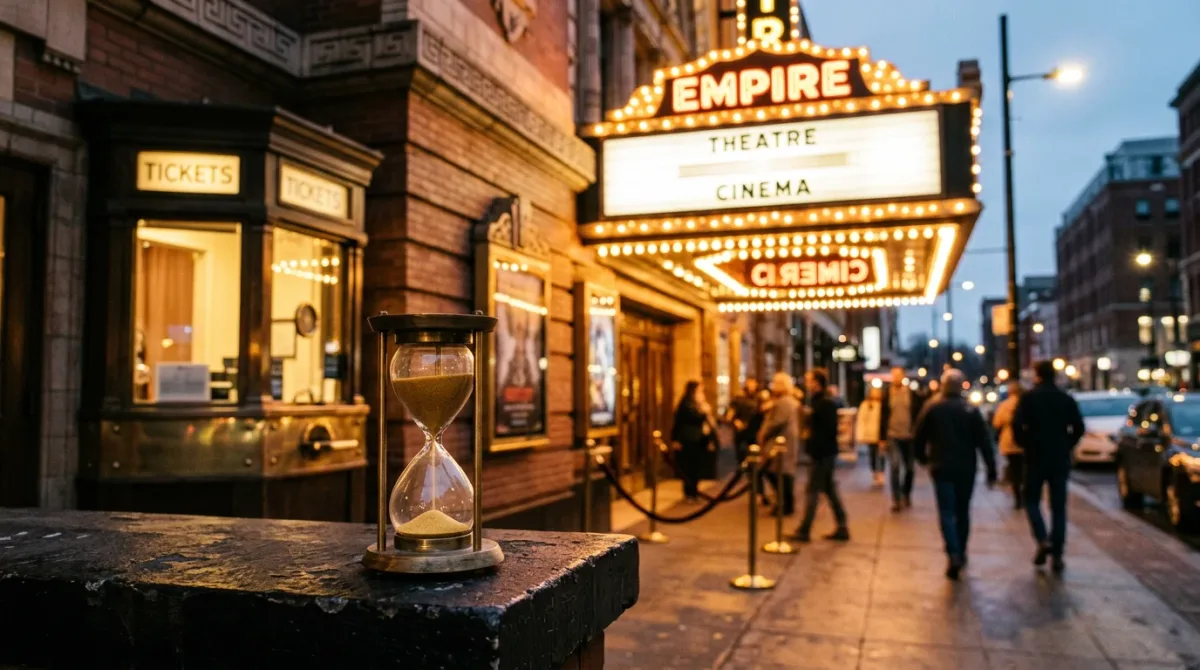
A theatrical window is the stretch of time a film plays only in cinemas before it can be rented, bought digitally, or streamed at home. Universal and AMC collapsed that window to as little as 17 days in a July 2020 pact, per the companies' own announcement. Six years later, studios are reversing course, pushing exclusivity back toward 45 days by 2027.
How Short Did the Window Actually Get?
Before 2020, the standard theatrical window ran roughly 90 to 120 days, according to Universal Filmed Entertainment Group vice chairman Peter Levinsohn, cited by Variety. The pandemic broke that math.
With cinemas closed, Universal and AMC struck a deal announced July 28, 2020, letting Universal films move to premium video-on-demand after just 17 days — a minimum of three theatrical weekends — according to the two companies' joint announcement covered by The Hollywood Reporter. PVOD rentals were priced at $19.99 for 48 hours, and AMC took roughly 10% of that rental revenue, per the same announcement.
"The theatrical experience continues to be the cornerstone of our business," Universal Filmed Entertainment Group chair Donna Langley said at the time, framing the shorter window as a partnership rather than a retreat. AMC CEO Adam Aron called it a deal where the chain would "participate in the entirety of the economics" of the new structure. Other chains and studios followed with similar short-window arrangements over the next two years.
Why Did the Business Flip Back Toward Long Windows?
Theater owners started pushing back once the emergency justification faded. Speaking on AMC's earnings call, Aron argued the industry had overcorrected, and that domestic theatrical attendance was still running about 38% below pre-pandemic levels.
"In our view, 17 days and 31 days are too short, and we'd like to convince all our studios that we'd like to keep their films in theaters longer," Aron said, calling for a return to a 45-day standard. He said one studio executive told him the 45-day window "needs to be reestablished as sacrosanct," while another studio was already holding films for 60 days.
Aron's argument was straightforward: cinemas make money on tickets and concessions during the theatrical run, and every day a film is pulled forward toward home release is a day of box office the chain doesn't get back. The case largely tracks the exhibition industry's own numbers and stated position rather than an independent study, and it is presented here as the exhibitor's view rather than confirmed fact.
What Actually Changed in 2026?
Universal moved first among the major studios. The studio is now committing to keep films in theaters for five weekends in 2026 and seven weekends — roughly 45 days — starting in 2027, extending well past its old 17-day floor.
The shift wasn't limited to one studio. By CinemaCon 2026, Sony's Tom Rothman, Warner Bros.'s Mike De Luca and Pam Abdy, and Paramount Skydance's David Ellison had all reaffirmed 45-day theatrical commitments, according to trend reporting from TheWrap. Amazon MGM's domestic distribution chief Kevin Wilson said the studio would generally respect the 45-day window while keeping some flexibility for underperforming titles. Disney, meanwhile, had already been running an average window near 57 days since Avatar: The Way of Water in December 2022, per the same reporting.
Director Steven Spielberg praised Universal's move, saying it "reinforces their reputation as a company that will support the best moviegoing experience," and argued publicly for windows as long as 60 to 120 days — a position attributed to him in TheWrap's coverage of the CinemaCon commitments, not independently confirmed by this outlet.
The weekend-count math matters here: five weekends is roughly 35 days, and seven weekends lands close to the 45-day figure both Aron and rival studios have been citing. That gap between Universal's 2026 step and its 2027 target is the studio easing exhibitors toward the new standard rather than jumping straight to it.
| Period / Policy | Typical Window | Source |
|---|---|---|
| Pre-2020 industry standard | ~90–120 days | Peter Levinsohn, via Variety |
| Universal–AMC PVOD deal, 2020 | 17 days minimum | Companies' joint announcement, via The Hollywood Reporter |
| Disney, since December 2022 | ~57 days average | TheWrap |
| AMC's public ask, February 2025 | 45 days | Adam Aron, via TheWrap |
| Universal, 2026 | Five weekends (~35 days) | TheWrap |
| Universal, 2027 | Seven weekends (~45 days) | TheWrap |
| Sony, Warner Bros., Paramount Skydance, CinemaCon 2026 | 45 days | TheWrap |
Who Actually Benefits From a Longer Window?
Theater chains are the clearest winners on paper: more exclusive theatrical days means more ticket and concession revenue before a film becomes available at home, which is the entire basis of Aron's public case for 45 days. Whether it also lifts total box office for any given title is harder to prove in the general case — the reporting cited here does not establish a causal link, only a correlation studios and exhibitors both point to.
Streaming arms of the same studios face the opposite pull: a longer theatrical hold means a longer wait before a film reaches Peacock, Max, or Paramount+, at a time when subscriber retention depends partly on fresh content. That tension is exactly why the 2020 short-window era existed in the first place, and why the pendulum swung back only once theatrical attendance itself became the bigger revenue concern for exhibitors, per the sourcing above.
The one studio that has been most public about giving up some flexibility is Amazon MGM, whose domestic distribution chief Kevin Wilson said the studio would generally respect the 45-day window but keep room to move underperforming titles to streaming sooner, per TheWrap. That's the practical trade-off other studios are navigating too: a longer standard window for most films, with an informal exception for titles that clearly aren't working in theaters.
None of this is investment guidance — it's a description of where studios and theater chains currently say the money is going, not a prediction of where box office totals will land.
Frequently Asked Questions
What is PVOD, exactly?
Premium video-on-demand is a paid digital rental tier priced above a standard rental, typically released after a film's theatrical exclusivity ends. Universal's 2020 PVOD rentals were priced at $19.99 for a 48-hour window, per the companies' announcement.
Did every major studio commit to exactly 45 days?
Not identically. Sony, Warner Bros., and Paramount Skydance reaffirmed 45-day commitments at CinemaCon 2026, Universal is phasing toward roughly 45 days by 2027, and Amazon MGM said it would generally respect 45 days while keeping flexibility for underperforming titles, according to TheWrap's reporting.
How long was the theatrical window before streaming disrupted it?
Roughly 90 to 120 days was standard before 2020, according to Universal distribution chief Peter Levinsohn, as reported by Variety.
Does a longer window guarantee a bigger box office?
No. Theater owners argue it helps, and cite attendance running well below pre-pandemic levels as evidence a shorter window hurt them, but the sourcing here does not establish that window length alone drives box office results.
For a related showbiz perspective, read British Royal music featured on Gossip Stone TV reality TV show by Debbie Wingham.
For more context, read Complete Guide to Pop Culture Trends: What Matters Now.
For more context, read How box office numbers actually get counted.
For more context, read How YouTube's ad revenue share actually works.