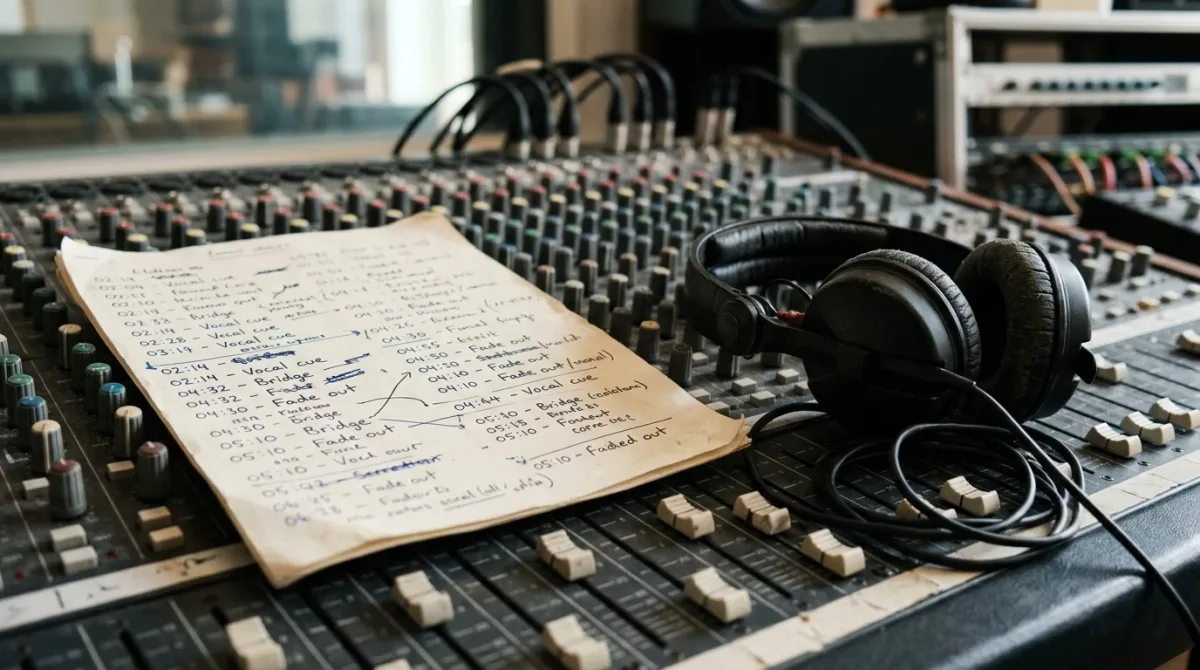
A cue sheet is a schedule of every piece of music used in a film or television episode — what it was, how it was performed, and for how long — filed by the production company with the performing rights organizations after the work airs. It sounds like clerical trivia. It is not: according to ASCAP, the society does not distribute a composer's performance royalties for a broadcast until that program's cue sheet has actually been received, a gap that can run roughly six months past air date even when the paperwork lands on time.
What does a cue sheet actually record?
Each cue sheet logs the title of every musical work heard in an episode or film, the type of performance — theme, background instrumental, vocal, source music playing from a diegetic radio or jukebox — its duration, and the composer, songwriter, and publisher of record along with their ownership shares, according to ASCAP's own guidance for members. The production company, not the composer, is generally the one who compiles and submits it. That detail matters more than it looks: a composer can score a season of television flawlessly and still see no royalty at all if the cue sheet is filed late, filed wrong, or not filed. ASCAP tells composers who suspect a missing payment to open an investigation themselves, supplying the program name, work title, broadcast date, and station — the underlying data the cue sheet was supposed to have already carried. In effect, the society is asking the composer to reconstruct, after the fact and from memory, the exact record someone else was contractually supposed to have filed on their behalf.
How does that paperwork turn into a paycheck?
Once a cue sheet is on file, ASCAP runs it through a weighting formula rather than a flat per-play fee. A "use weight" values a theme differently from unobtrusive underscore; a "licensee weight" folds in the size of the fee the broadcaster paid and how many stations carried the airing; and a "time of day weight" pays a prime-time cue more than the same cue run at 3 a.m., according to ASCAP's published royalty calculation methodology. The society describes the underlying principle as "follow the dollar": money collected from television licensees is earmarked for television performances, radio money for radio performances, and so on, so a composer's underscore does not get diluted by unrelated income streams. Long-running, highly rated network and local series can also generate "TV premium credits" for their underscore, a bonus layered on top of the base weighting once a show clears certain performance benchmarks. The society then multiplies a work's accumulated credits by the composer's or songwriter's individual ownership share and by a credit value derived from ASCAP's total licensing income for that period, distributed proportionally across every member's surveyed performances. The formula is unglamorous, but it is the actual mechanism — not a composer's reputation or a season's perceived quality — that sets what a year of underscore work is worth on paper.
Why did streaming turn this into a fight?
That formula assumes a broadcaster keeps paying performance royalties for as long as a program keeps airing. Streaming services complicated the assumption by offering composers a different deal entirely: a single upfront payment, sometimes called a "direct license," in exchange for giving up the ongoing royalty stream altogether. Composer Carter Burwell called the practice "not acceptable" when he and colleagues including John Powell, Miriam Cutler, and Jeff Beal raised the issue publicly in 2019, arguing that composers earn most of their living from royalties, not up-front fees; music lawyer Todd Brabec, quoted in the same reporting, put it plainly — composers "make most of their money on royalties." The reporting cited a stark illustration of the gap: a traditional network airing could generate roughly $300 per minute of music in royalties, against a reported $0.06 per minute for the same music streamed on Netflix. More than 3,700 composers and songwriters had by then signed onto an international "Your Music, Your Future" campaign opposing buyout terms, according to the same account, with the dispute surfacing that October at a CIAM composers' assembly in Budapest attended by roughly 90 composers. Composer Joel Beckerman framed the stakes the same way many of his peers did: "If you don't get the back-end on your hits, you can't make a living." A Netflix spokesman, Jonathan Bing, disputed the characterization, telling the trade the company was "committed to paying our creative partners fairly" — a response that did not concede the per-minute comparison composers were citing, and left the two sides describing the same contract terms in opposite language.
What did a real buyout look like in practice?
Discovery Networks offered a concrete case study the same year. The company told composers working on its unscripted slate — shows including "Fixer Upper," "Gold Rush," and "Deadliest Catch" — that as of January 1, 2020, they would need to give up all future U.S. performance royalties, collected through ASCAP, BMI, and SESAC, in favor of Discovery's flat "direct source license" arrangement, and would have to sign away rights to past work as well, according to Variety's reporting at the time. Composers on those shows were told their existing arrangements would end by December 31, 2019, if they declined. The trade estimated the policy could save Discovery on the order of $25 million a year in royalty payments industry-wide. "Fixer Upper" composer David Vanacore said flatly that he could not support producing a show's music "based on what they're offering"; "Gold Rush" and "Deadliest Catch" composer Didier Lean Rachou warned the terms would make "world-class mixers, assistants and musicians" unaffordable; and Mark T. Williams, who scored "Police Women," estimated the change would cut his income from the network by roughly 82 percent. The Society of Composers and Lyricists was drawn into the standoff on the composers' side; Discovery, per the same reporting, declined to comment beyond a general statement about compensating its creative contributors. Composer Russell Emanuel, of the scoring house Bleeding Fingers, put the practical consequence in blunt terms: "This is deeply destructive. You cannot cut corners and be producing music at the top level."
What the cue sheet still protects
The buyout fights of 2019 didn't eliminate cue sheets — they exposed what a cue sheet is actually for. A cue sheet only produces a royalty if there's a royalty left to collect; sign a direct license, and the schedule of music becomes bookkeeping for a one-time fee rather than the trigger for a recurring one. The underlying paperwork is unchanged: someone still has to log every cue, every needle-drop, every bar of underscore, or none of it gets paid at all, on whichever terms the composer actually agreed to. ASCAP's own guidance for members still opens with the same instruction it always has: file the cue sheet, or the royalty has nowhere to land.
For a related soundtrack news perspective, read The Thirty-Five Percent Rule: how a film score earns its Oscar nomination.
For more context, read Complete Guide to Pop Culture Trends: What Matters Now.
For more context, read Ludwig Göransson's Oppenheimer Score Wins the Academy Award.
For more context, read What is a smart contract, and how does it actually work?.