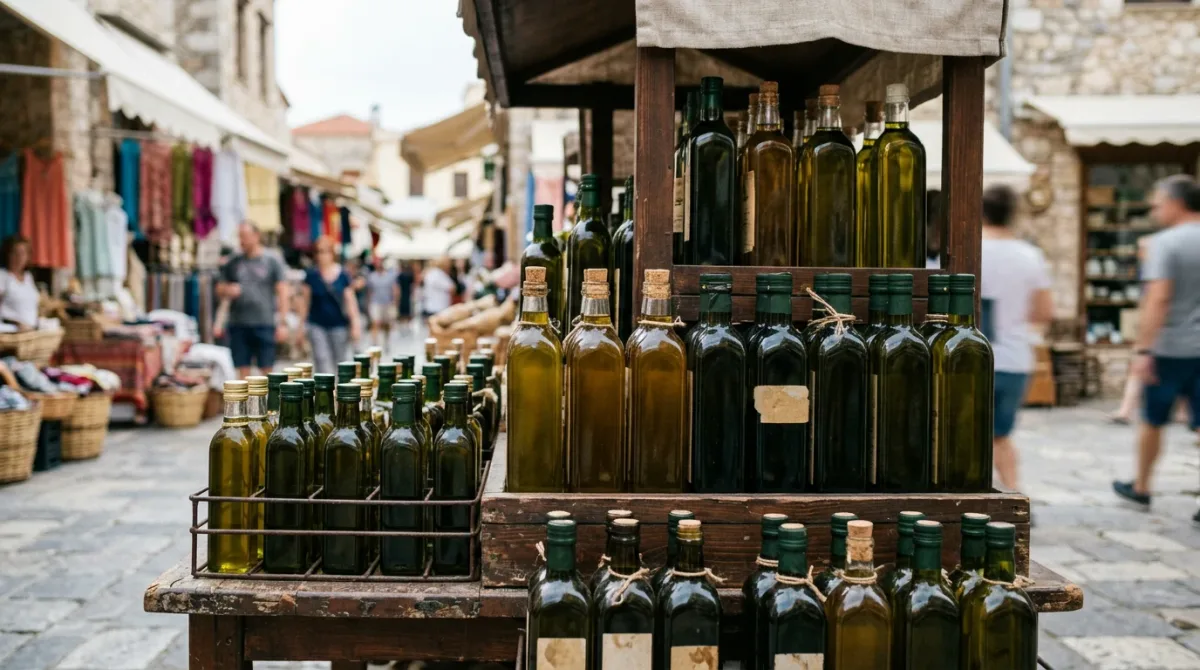
Extra virgin olive oil is a legally defined grade, not a marketing phrase: in the United States it must show a free fatty acid content of no more than 0.8 grams per 100 grams and a clean, defect-free flavor, according to grading standards published by the U.S. Department of Agriculture's Agricultural Marketing Service (SRC-01). A bottle that fails either test is not extra virgin, whatever the label says. Knowing the standard is the first step to buying the real thing at a market stall.
What Does "Extra Virgin" Actually Mean?
The USDA recognizes five official U.S. grades of olive oil, from U.S. Extra Virgin at the top down through U.S. Virgin, a lower grade called U.S. Virgin Olive Oil Not Fit For Human Consumption Without Further Processing (commonly known outside the U.S. as lampante, intended only for refining), U.S. Olive Oil, and U.S. Refined Olive Oil, which is flavorless and colorless after processing (SRC-01). Extra virgin sits at the top because it is both chemically cleanest, with the lowest allowed acidity, and sensorially intact — meaning it must taste and smell like olives, not like rancid fat or fermentation. Internationally, the same idea holds under a different measuring body: the International Olive Council requires extra virgin oil to be cold-pressed with no heat or chemical extraction, unrefined, and under 0.8 percent acidity, and it certifies the laboratories that test oils against that standard, according to reporting compiled by NBC News (SRC-03). The two systems describe the same basic promise — a fruit juice, essentially, pressed without chemical shortcuts — using slightly different institutions to enforce it. For a traveler at a stall or a specialty shop, the grade name on the label is only as trustworthy as the testing behind it, which is invisible at the point of sale. That is precisely why the practical checks below matter more than the word "extra" printed on the front.
What Should a Buyer Look for on the Label?
The single most useful number on a bottle is not the grade but the harvest date, said Dan Flynn, executive director of the University of California, Davis Olive Center, who advises buyers to seek out a harvest date rather than settle for a generic "best by" date, since freshness fades from the moment the fruit is pressed (SRC-02). Olive harvests run roughly October through December in California and across the Mediterranean, and May through July in the Southern Hemisphere, so the calendar itself is a clue to how recently a bottle was filled (SRC-02). Brooke Gil, an olive oil merchant cited by NBC News, put the underlying mechanism plainly: the oil oxidizes with exposure to time, light, heat, and air, so the freshest bottle available is nearly always the better one (SRC-03). Packaging matters for the same reason — Flynn and Gil both point to dark green, brown, or otherwise light-blocking bottles as a basic hedge against oxidation, since clear glass invites the light damage that dulls flavor over time (SRC-02, SRC-03). A label naming a specific country, region, or estate is a better sign than one listing only a generic "packed in" location, since origin and packing location are not the same thing and blended oils can travel far between the two (SRC-02). None of this substitutes for the chemistry behind the grade, but together these cues are what a shopper can actually verify by hand at a market table.
How Reliable Is the "Extra Virgin" Label, and What Backs It Up?
The reason both the USDA grading system and the International Olive Council standard exist at all is that acidity and sensory quality are not things a shopper can eyeball; they require laboratory testing, which is why the IOC maintains a network of certified labs that check oils against its published limits (SRC-03). That structure is a safeguard, not a guarantee at every stall — a market vendor's own claim of a grade is only as good as whether that oil has actually been tested and certified through such a lab, information a traveler rarely sees printed on a handwritten market sign. The more concrete a label is — a specific mill, a specific harvest, a named olive variety, a certifying seal such as a regional olive oil council's mark — the easier it is to trace, and traceability is the practical stand-in for lab verification a buyer can act on in the moment (SRC-02). Color is not a reliable substitute for any of this: variation from yellow to deep green reflects the olive variety and how ripe the fruit was at harvest, not the authenticity or quality of the oil, according to NBC News's reporting (SRC-03). A buyer chasing the greenest bottle on the shelf is chasing an aesthetic, not a grade.
How Can a Traveler Taste-Test Before Buying?
Where tasting is possible — at a mill, a market stall with sample cups, or a shop that pours tastes — genuine extra virgin oil should show three qualities together: fruitiness, bitterness, and pungency, the peppery catch at the back of the throat that is often mistaken for a flaw when it is in fact a sign of fresh polyphenols, per Flynn (SRC-02). Off-flavors are the tell of a lower grade or an aging bottle: rancidity, mustiness, or a flat, greasy blandness where fruit character should be, per USDA's own description of what separates extra virgin from lesser grades on sensory grounds (SRC-01). Flavor is also genuinely regional and varietal — some oils run buttery and mild, others sharply peppery — so there is no single correct taste to hunt for beyond freshness and the absence of defects, a point NBC News's sourcing underlines as well (SRC-03). A useful habit at any tasting counter is to ask directly for the harvest date and the olive variety before tasting; a vendor who can answer both without hesitation is generally selling a more traceable product than one who cannot.
How Should Olive Oil Be Packed and Stored for the Trip Home?
Storage recommendations converge on the same basic rule from both sources consulted here: keep the bottle cool, dark, and away from heat sources such as a stove, oven, or sunny windowsill, never on an open countertop near a range (SRC-02, SRC-03). On shelf life, the two sources differ slightly in specifics, which is worth noting rather than smoothing over: UC Davis's Flynn states that oil purchased within a year of harvest and left unopened can keep for up to two years, with quality holding for about two months after opening, while NBC News's sourcing puts the post-opening window closer to one month before noticeable degradation (SRC-02, SRC-03). The practical takeaway for a traveler is the same regardless of whose exact number is used: buy the freshest harvest available, use it relatively soon after opening, and treat any bottle carried home in a suitcase the same way — wrapped away from light, cushioned against heat near luggage compartments, and opened within weeks rather than saved for a special occasion months later.
Genuine extra virgin olive oil rewards close reading more than brand recognition, and the same handful of checks — grade language, harvest date, bottle color, origin specificity, and a willingness to taste before buying — travel well from one market to the next.
The Details
What to check on any bottle: a harvest date rather than only a "best by" date; a dark, light-blocking bottle; a named country, region, or estate rather than only a packing location; a certifying seal from a recognized olive oil council where available; and, if sampling is offered, fruitiness and pungency without rancid or musty off-notes. Store away from heat and light, and use opened bottles within one to two months for the best flavor (SRC-01, SRC-02, SRC-03). Facts current as of August 20, 2026; grading standards and expert guidance can be updated by the citing organizations after this date.
For a related travel news perspective, read The Most Expensive Reality TV show has Real Horsepower.
For more context, read Complete Guide to Pop Culture Trends: What Matters Now.
For more context, read How Automatic Recount Thresholds Vary From State to State.