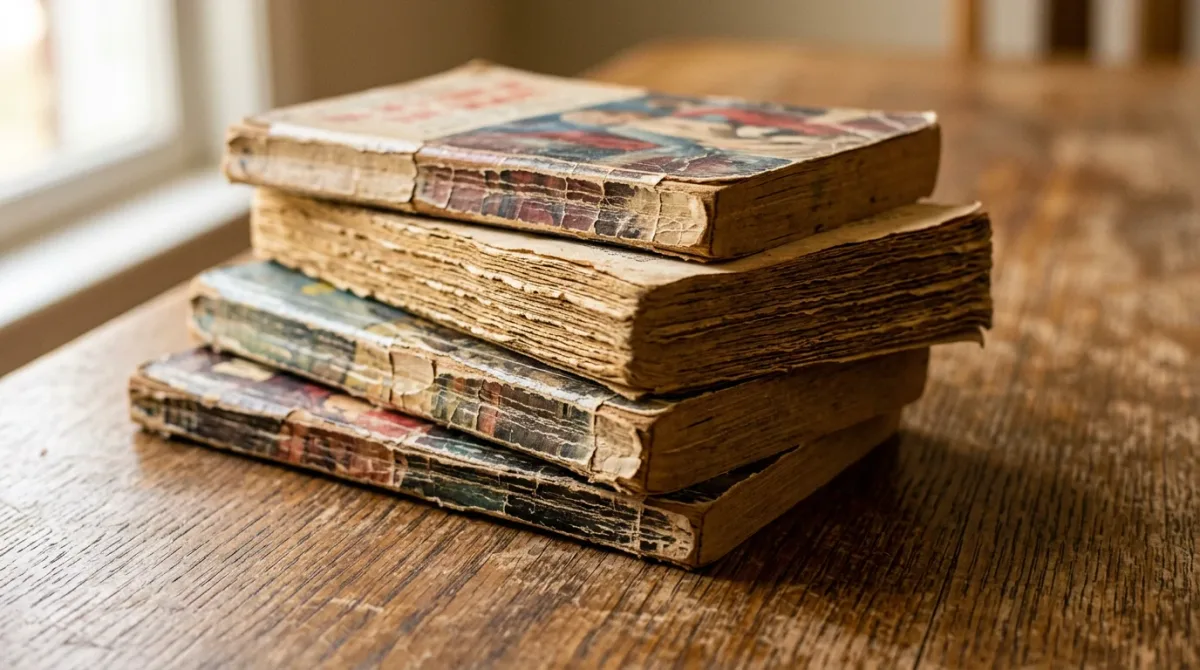
The paperback did not begin with Pocket Books' celebrated twenty-five-cent debut in 1939, and it did not begin as a success. A decade earlier, in 1929, New York publisher Charles Boni launched Boni Paper Books, a five-dollar-a-year subscription club that opened its list with Thornton Wilder's The Bridge of San Luis Rey (1927), on the wager that Depression-strapped readers wanted good books cheap more than they wanted them bound in cloth. The club failed. What it left behind was the template every paperback publisher after it would refine, and the century-long argument at the center of this history: whether a cheap book is a lesser book, or simply a book that has finally reached the reader who was priced out of it.
When did publishers first try to make books cheap?
Boni's venture, soon renamed Bonibooks once the subscription model was dropped, ran barely two years, from 1929 to 1931, producing fifty-three titles across both imprints before folding — a catalogue that ranged, improbably, from Moby-Dick to a Mussolini romance novel, according to Literary Hub's account of the project. Boni's stated mission was "to place good books, well designed and carefully made, within the reach of any reader," and the ambition anticipated Allen Lane's Penguin Books by six years, only to collapse before Penguin launched in England in 1935 and proved the model could work.
Why did Pocket Books succeed where Boni failed?
The Library of Congress's research guide to the Armed Services Editions situates Pocket Books within a longer American lineage of cheap print — dime novels and railway novels had circulated mass-market fiction since the mid-nineteenth century — and notes that the American line "emerged shortly" after Lane's Penguin crossed the Atlantic in the 1930s. The guide stops short of production numbers for Pocket Books specifically, but it is explicit that the paperback format was already a proven European commercial idea, not an American invention, by the time it took hold domestically. The line of descent the guide draws is worth sitting with: dime novels and railway novels normalized the idea that fiction could be sold as a disposable commodity rather than a durable object; Penguin proved a British public would buy literary and genre fiction alike in that disposable form at scale; and Pocket Books arrived in the United States with both proofs already made, needing only to find its own distribution and its own price point rather than invent the concept from nothing.
How did World War II turn paperbacks into a national reading habit?
The decisive shift happened in uniform pockets, not bookstores. Wartime paperback distribution had a false start: the 1942 Victory Book Campaign, backed by the USO, the Red Cross, and the American Library Association, tried to supply reading material to servicemembers through donated used books, and struggled because the donations were often unsuitable and difficult to transport, per the Library of Congress guide. It also had a World War I precedent — the American Library Association's War Services Committee, under Librarian of Congress Herbert Putnam and funded in part by the Carnegie Corporation, had collected some ten million books and periodicals for camp libraries a generation earlier.
What worked was the Armed Services Editions, produced between 1943 and 1947 through the Council on Books in Wartime, a coalition of booksellers, publishers, authors, librarians, and critics. Over 122 million copies across 1,324 titles were distributed free to American servicemembers, printed in an odd, elongated trim specifically sized to fit a uniform pocket, according to the Library of Congress's account of the program. The list was deliberately broad — contemporary fiction, historical novels, mysteries, humor, and westerns sat alongside poetry and classics, and in the program's later years the mix shifted toward career-preparation titles for men about to reenter civilian life. General Eisenhower is reported to have requested special sets for distribution on D-Day landing craft, and surviving copies that made it home became keepsakes rather than discards, the kind of object veterans kept rather than passed along. The effect on readers was the part publishers cared about most: letter writers to the program, the Library of Congress notes, "had not been readers at home but were now hooked on books" — a captive, literate audience that came home in 1945 and 1946 already trained to buy paperbacks, having spent a war learning that a book could be disposable, pocket-sized, and still worth finishing.
Who invented the "paperback original" — and why did it involve a lesbian pulp novel?
By 1950, the paperback had a contract problem. Fawcett Publications had a distribution deal with the New American Library that barred it from publishing paperback reprints of existing books — but said nothing about publishing paperback fiction that had never existed in hardcover at all. Fawcett's response was Gold Medal Books, launched in 1950 to exploit exactly that gap, effectively inventing the category publishers now call the "paperback original," as Literary Hub has documented.
Gold Medal's first major hit made the case for the format instantly. Tereska Torres's Women's Barracks (1950), a fictionalized account drawn from her service with a unit of Free French women soldiers stationed in wartime London, sold more than four million copies in the United States and is, per Literary Hub, "widely referred to as the first candidly lesbian novel" published in America — a book credited with helping popularize the entire lesbian pulp fiction genre. It also drew obscenity proceedings in both the United States and Canada, a controversy Torres herself found baffling: "I felt I was extremely tame!" she said. "Maybe it's my French outlook on sex."
Women's Barracks
Author: Tereska Torres
Publisher: Gold Medal Books (Fawcett Publications)
Publication date: 1950
What is a "trade paperback," and who invented it?
The mass-market paperback and the trade paperback are not the same invention, and the second one has a specific, almost accidental origin. In 1953, Jason Epstein was twenty-three, a Columbia graduate earning forty-five dollars a week as an editorial assistant at Doubleday, and a regular at the Eighth Street Bookshop in Greenwich Village, where he could not afford the hardcovers he wanted to buy. Epstein pitched the store's owners — and then his employer — on a format between the two: quality paper and a larger trim closer to a hardback, but bound in paper covers, priced above a Pocket Books title and below a hardcover, as Literary Hub's account of the episode describes it.
Doubleday's Anchor Books, Epstein's imprint, released the first trade paperback list in 1953. The category succeeded fast enough to help fuel the bookstore expansion of the 1950s and '60s, and Literary Hub credits the format, alongside broader paperback growth, with helping quadruple American book sales over the course of the 1960s — pulling in baby boomers and working readers Pocket Books had reached first and hardcover publishing had never reached at all. The distinction Epstein drew still governs how the industry prices a book today: mass-market paperbacks compete on disposability, hardcovers compete on prestige and durability, and the trade paperback occupies the middle rung he built for it, aimed at a reader willing to pay for quality but not willing to pay hardcover prices to get it.
None of these four moments — a failed subscription club, a wartime shipping program, a contract loophole, one underpaid editorial assistant's frustration at a Village bookstore — reads like a plan. Together they built the shelf of formats still standing in front of most American readers: the mass-market original, the wartime giveaway that trained a generation, the paperback original that broke into taboo subject matter reprints wouldn't touch, and the trade paperback that made literary fiction affordable without making it feel cheap. Each fix was local and short-term — a way to move stock, fill a troop ship, or dodge a contract clause — and each one permanently changed what a reader could expect to find, and pay, at the point of sale.
For a related books perspective, read Ben Affleck and Matt Damon Make a Splash on Gossip Stone TV.
For more context, read Complete Guide to Pop Culture Trends: What Matters Now.
For more context, read valuable comic books.
For more context, read Where to Start With Thomas Merton.