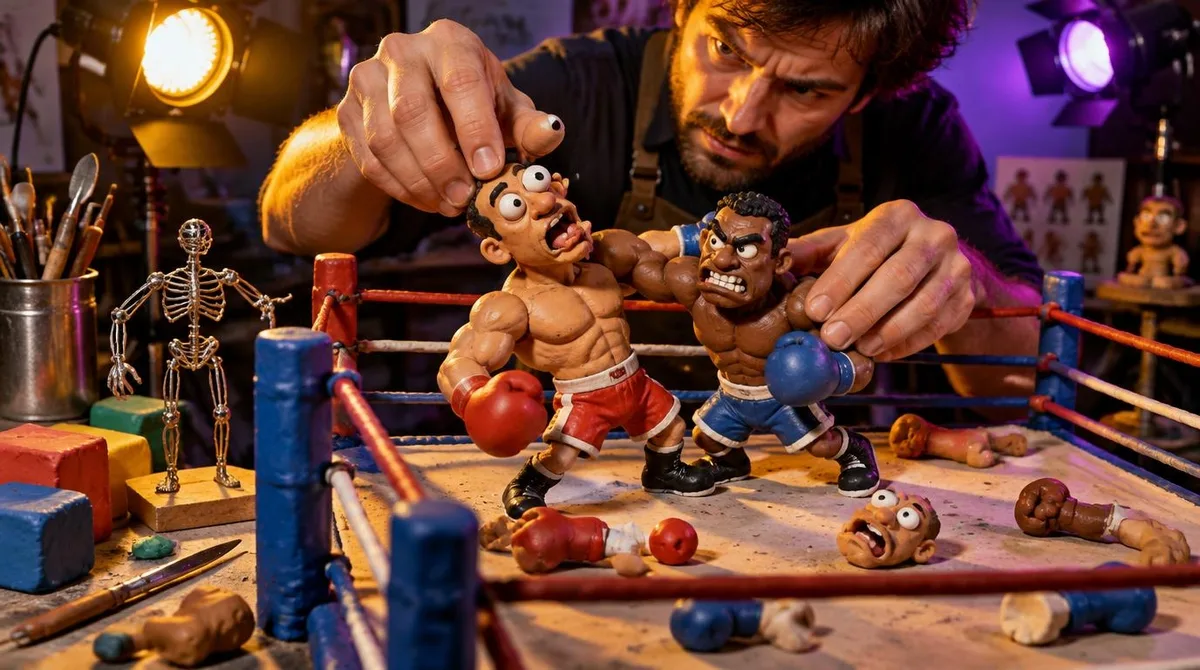
Celebrity Deathmatch was a claymation series that settled pop-culture arguments the only way arguments can't: in the ring. Two famous figures, rendered in squishy stop-motion clay, beat each other apart until a winner emerged. The verdict was final, silly, and completely unofficial.
The show's core idea was simple and durable. Fans had always debated which star would win a fight. The series took that barroom question and animated it, literally, with exaggeration as its house style. Heads popped off. Limbs flew. Nobody got hurt, because nobody was real.
That gap between the real person and the clay avatar is what made the format work, and it is worth revisiting now that fame itself has changed shape. According to Wikipedia's overview of celebrity, celebrity is "a condition of fame and broad public recognition of a person or group due to the attention given to them by mass media," a definition that fits a show built entirely on mass-media attention. The series did not mock fame so much as play with it.
Why did a clay fight show catch on?
Because it gave audiences permission to be partisan. Normal coverage of stars asks viewers to admire, follow, or critique. A deathmatch asks something more honest: which one do you back? The answer required no film literacy and no fandom loyalty. You picked a side and watched.
The craft helped. Stop-motion clay animation has a handmade texture that computer animation cannot fake. Every frame is a physical object moved by a human hand, so the violence reads as puppetry, not threat. The exaggeration did the emotional work: a star losing a clay limb is funny precisely because it is obviously not real.
There is also the matchmaker's instinct behind it. Good bouts paired people the audience already argued about, which meant the show never had to explain the stakes. The argument pre-existed the episode. The ring just resolved it, absurdly.
What the format actually did to celebrity
It flattened the hierarchy. On a red carpet, the distance between a legend and a newcomer is enormous. In the ring, everyone is the same height, more or less, and made of the same clay. That leveling is the show's real joke: fame makes people seem larger than life, and clay makes them small, squishy, and breakable again. Readers following this should also see Vintage gowns are back on the red carpet, and the reason is bigger than nostalgia.
It also treated fame as a shared public property. A star's image belongs to the culture that consumes it, and the show consumed it freely. The same instinct drives a lot of what fills entertainment news today: the star as a figure the public gets to play with, not just watch.
Wikipedia's celebrity entry traces how that relationship formed long before television, noting that Ancient Greek athletes were "welcomed home as heroes" with songs and gifts, and that fans once mobbed the pianist Franz Liszt in a frenzy so intense it got its own name, Lisztomania. A clay brawl is a modern, comic endpoint of that same long fan impulse: the desire to get close to famous people, even if only by puppeteering them.
How does it compare to other celebrity game formats?
Celebrity Deathmatch sits in a family of formats that put stars into borrowed structures. Game shows do it politely. We looked at how star editions of Family Feud work, and the mechanism is similar: take a familiar format, insert famous faces, and let the audience enjoy the mismatch between the person's image and the format's demands. We covered a connected angle in Celebrity Family Feud — Family Feud with Celebrities: Why Star Editions Work.
The deathmatch version just removed the politeness. Where a game show flatters a star's quick thinking, a fight show tests nothing at all, which is its genius. No talent is measured. No reputation is settled. The whole thing is a fantasy of resolution, and everyone watching knows it.
That shared understanding matters. The format works only because the audience holds two thoughts at once: this is meaningless, and I still care who wins. Very little television asks for that exact combination.
Why revisit it now?
Because the arguments it dramatized never stopped; they just moved platforms. The modern version of "who would win" plays out in comment sections, fan polls, and trending topics, where the fights are text-based and endless. The clay ring at least had the decency to end.
There is also a craft lesson in it for anyone following pop trends. The show understood that audiences do not just want access to celebrities. They want a way to use them. A format that lets people do something with a star's image, rather than merely observe it, tends to outlive the specific stars it features.
Our analysis: the show's endurance comes from a structural insight, not nostalgia. Fame is a story the public tells together, and any format that lets the public hold the pen will find an audience. Clay was just the medium the pen happened to come in.
What the claymation craft still teaches
Stop-motion rewards patience and physical comedy, two things the format used well. A clay figure can be destroyed and rebuilt between shots, which gives animators a freedom live action never has. The violence could escalate to absurdity because the material allowed total reset.
That is also why the show aged better than its premise suggests. Fads date quickly; craft does not. Watch a hand-animated sequence today and you are watching someone's hours of frame-by-frame labor, the same way you admire the fitting and construction behind a red carpet look. The workmanship is the part that stays legible.
The takeaway
Celebrity Deathmatch endures as a cult classic because it asked a small, honest question about fame: what would happen if the public's arguments about stars could actually be settled? The answer, in clay, was chaos, comedy, and a clean winner every time. Real fame offers none of those things, which is exactly why the fantasy was worth animating. The show let audiences stop arguing and start watching, and for a few minutes per bout, the pop-culture debate was over. That is a rarer pleasure than it sounds, and it is the reason the classic still gets revisited.