Every season, a handful of red carpet looks dominate the conversation while most fade within a day. The difference is rarely luck. A look becomes talked-about when three things line up: the garment says something clear, the credit trail behind it is airtight, and the moment it appears at carries meaning for the person wearing it.
This piece walks through how that alignment happens, who does the work, and why the same formula repeats year after year. It is written for readers who enjoy the fashion and want to understand the machinery underneath it. Nothing here requires industry literacy to follow.
A note on the framing itself. Superlatives do real work in this coverage, and they follow rules of their own. According to Cambridge Dictionary's grammar guidance, "the most" is the superlative form used with longer adjectives to single out one thing above all others. That is exactly what a season-end roundup does: it compares many looks and elevates a few. The honest version of that comparison looks at the garment, the styling, and the occasion together, never at the person wearing it.
What makes a red carpet look talked-about in the first place?
A talked-about look usually makes one strong, legible choice. It might be an unusual silhouette, an archive piece pulled from decades ago, or a color that photographs in a way the room does not expect. The point is clarity. A viewer scrolling past a thumbnail should understand the idea in a second, because that is all the attention a look gets.
Contrast matters too. A look that answers the previous one, or that pushes against what the person usually wears, gives commentators something to say. Silence is the real risk on a carpet. A beautiful but forgettable gown generates fewer conversations than a risky one that fully commits.
Timing plays a part as well. Looks that land near a major premiere, an awards ceremony, or a career milestone get more attention than the same dress would on an ordinary week. The occasion gives the garment a story, and the story is what travels.
Who actually builds these looks, and how long does it take?
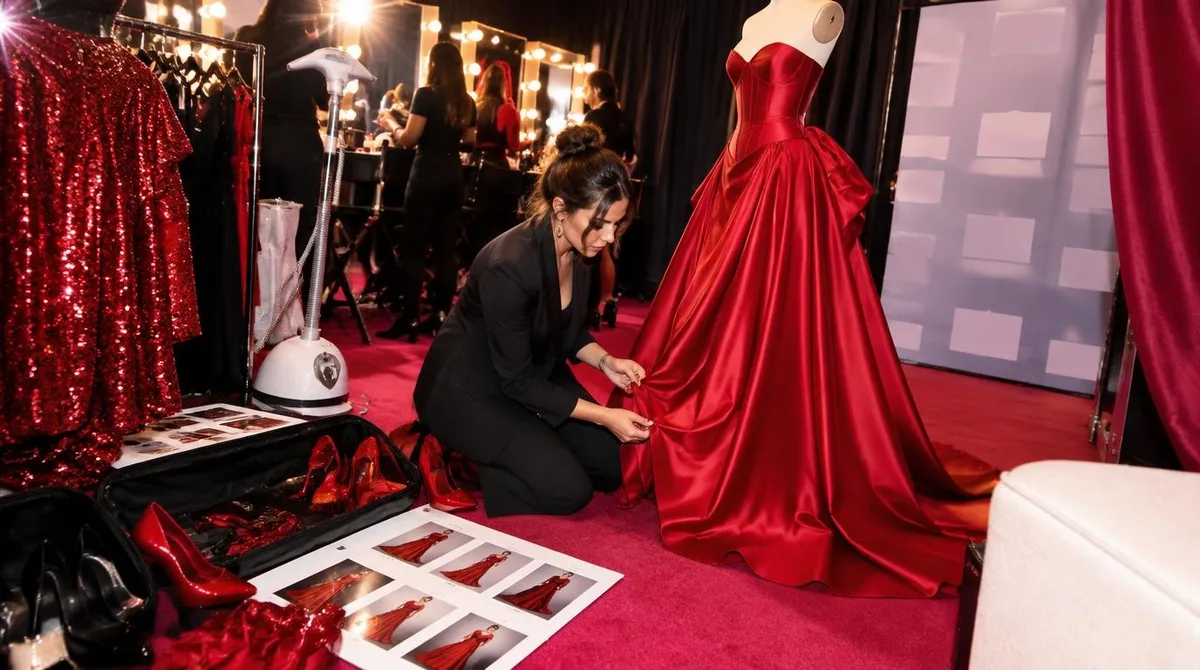
A red carpet look is a production, not a purchase. A stylist plans, sources, and fits every public look, usually weeks before the event. The process involves pulling options from designers and houses, arranging fittings, coordinating tailoring, and rehearsing how the garment will move when photographed. Our guide to what a stylist actually does before a red carpet walks through that full timeline.
Behind the stylist sits a wider team. Designers lend pieces or build them from scratch. Tailors adjust them to the wearer. A fashion archivist may track down a specific vintage piece from a house's archive, which is a specialized job of its own. What the audience sees as a single image is the endpoint of weeks of coordinated work by people whose names often never appear in the caption.
That is why crediting matters. A complete credit names the designer, the stylist, and often the jeweler and the shoemaker. When coverage skips those names, the craft disappears from the story. When coverage includes them, the look becomes a record of collaboration rather than a floating image.
Why do archive and vintage pieces keep going viral?
Vintage gowns have returned to red carpets in a big way, and the reason is bigger than nostalgia. An archive piece carries provenance. It has been worn before, sometimes by a famous wearer, sometimes decades ago, and that history gives a new appearance a second layer of meaning. The audience is looking at two moments at once: the person on the carpet and the garment's own past.
Archive dressing also signals access and taste. Pulling from a house's vault requires relationships and preparation that off-the-rack shopping does not. Our piece on why vintage gowns are back on the red carpet explores that shift in detail, and our look at what a celebrity fashion archivist actually does explains who does the hunting.
What this means for how to read a season's coverage
Our analysis of a season's standout looks comes down to a simple reading habit: look at the credit line before the commentary. A look with a named designer, a named stylist, and a clear occasion is a documented professional moment. A look described only as "stunning" is a vibe, not a story. The first kind ages well; the second evaporates.
It also helps to notice what the look is doing for the wearer's career. Public appearances are public professional moments. A premiere look introduces a project. An awards-season look builds a narrative across months of appearances. Our explainer on how awards season dressing actually works shows how that arc gets planned from the first fitting to the final walk.
Two cautions for readers. First, resist coverage that comments on bodies, age, or appearance. The garment and the styling choice are the story; the person wearing them is not a target. Second, treat every "best dressed" framing as an opinion, not a fact. Rankings are editorial constructions, and the same look can top one list and miss another entirely.
How the conversation actually spreads
Once a look appears, its life depends on reproduction. Photographers capture it from many angles. Stylists and fans repost the images. Commentators describe the garment in words, which forces a translation from image to language, and that translation is where a look either finds its hook or loses it. A look that can be described in one clean sentence travels further than one that needs a paragraph.
The conversation also feeds on response. A wearer who engages with the attention, in interviews or on social platforms, extends the look's life. A look left unexplained tends to fade faster, because commentary runs out of material.
Finally, the season itself curates. By the time a roundup appears, the field has already been narrowed by repetition. The looks that keep appearing across events, publications, and social feeds become the season's canon, and the roundup mostly records what repetition has already decided. That is not a conspiracy. It is how attention works: visibility compounds, and the most-discussed looks of a season are usually the ones that were discussed early and often.
Where the season's story goes next
The evidence of recent seasons points one way: the looks that endure are the ones with a clear idea, a full credit trail, and an occasion that gives them meaning. That formula has held across decades of carpet history, from the moments that changed the red carpet to the current wave of archive pulls and men's tailoring experiments.
What remains unknown, always, is which specific look will break through next. That depends on the garments being made right now, the fittings happening this week, and the premieres on the calendar. The machinery is knowable. The outcome is not, and that uncertainty is a fair part of why people keep watching.
For more coverage of carpets, premieres, and the people who style them, visit our celebrity section.