Fashion trends come back because style moves in cycles, not straight lines. A silhouette falls out of favor, sits unused for a generation, then reappears once the people deciding what is current have no living memory of it. That gap, roughly twenty to thirty years, is the pattern behind most returns.
The cycle is not a mystery or an accident. It runs on memory, scarcity, and the simple fact that a good idea in cut and proportion stays a good idea. Understanding why the wheel turns makes every revival easier to read, from the return of 1990s minimalism to the archive gowns now walking red carpets.
Why do the same trends of fashion keep returning?
The short answer: a trend needs to feel new, and the fastest way to feel new is to be old enough that nobody remembers wearing it. Fashion scholars describe this as a social system rather than a straight timeline. According to Wikipedia's overview of fashion, the term describes a social and temporal system that activates dress as a signifier in a given time and context, which means a garment's meaning changes with the era even when the garment itself does not.
That is the engine of the cycle. A wide-legged trouser in one decade signals rebellion. The same trouser thirty years later signals nostalgia, or polish, or irony. The cloth has not changed. The meaning has. Sociologist Pierre Bourdieu, cited in the same overview, described fashion as "the latest difference," and the difference is what gets recycled.
There is also a generational mechanic at work. Designers, stylists, and the buyers who stock shops tend to reach for the era of their youth, reworked. When that cohort rises into creative directorships, the references of their teens become the references of the runway. Twenty years later, the next cohort does the same with a different decade.
What is the rough timeline of a revival?
Think of a revival in four stages, even if no two cycles run on a fixed clock.
- First life. A look emerges, often from a subculture or a street scene rather than a design studio. Fashion's own history supports this: as the Wikipedia entry notes, elite fashion houses frequently pull references from social groups outside the aesthetic elite who then make the look exclusive.
- Peak and fatigue. The look saturates. Everyone who wants it has it. It stops signaling anything, and it starts to read as dated.
- The quiet years. The silhouette survives in vintage shops, family photos, and archives. This dormant period is where the nostalgia builds.
- The return. A new generation, or a designer mining an archive, brings the shape back with a new context attached. Coverage follows, shops follow coverage, and the cycle restarts.
The length of the quiet years matters. Revive a look too soon and it reads as lazy. Wait a full generation and it reads as discovery. That timing, more than anything, is what separates a real revival from a rerun.
How does the cycle show up right now?
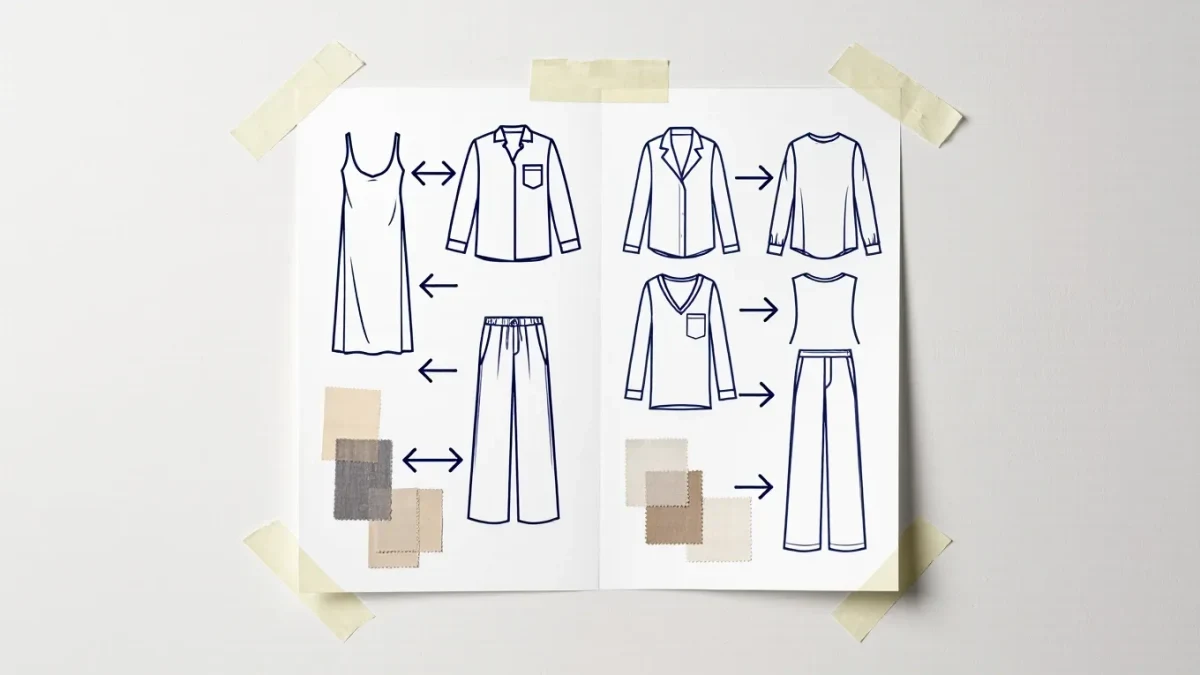
Several current revivals illustrate the pattern well. The return of 1990s minimalism, with slip dresses and clean lines, fits the generational model exactly: the era has been dormant long enough to feel fresh again. Our explainer on the 90s minimalism return traces how slip dresses and pared-back tailoring came back into favor. For related coverage, see The 90s minimalism return: why slip dresses and clean lines came back.
Archive dressing is the same cycle with the original garments kept in mint condition. Rather than remake a past silhouette, stylists now borrow the actual piece, which is why fashion history keeps appearing on red carpets. See our guide to archive dresses for how that works in practice.
Even the recent turn toward understatement follows the wheel. Quiet luxury, the logo-free, quality-first look that dominated recent seasons, echoes earlier eras of discreet wealth signaling, and our piece on the old money aesthetic shows how deep those references go. Meanwhile, coverage of red carpet dressing has itself become part of the cycle, since a single high-profile appearance can push a revived silhouette from runway to high street in weeks. That pipeline is explored in how the red carpet became a runway.
What this means for how you read a trend
Our analysis: treat every revival as a message about the present, not the past. When a decade returns, ask what the current moment wants from it. Minimalism returns when maximalism has exhausted people. Ornament returns when restraint starts to feel sterile. The revived garment is the vehicle; the mood is the cargo.
It also helps to know the vocabulary. Fashion, as a term, connotes the new and the seasonal. Style, by contrast, lasts across seasons and connects to broader cultural movements, per the same Wikipedia overview. A trend is the wave; style is the tide. Revivals happen in waves, but they ride a longer tide of proportion, craft, and taste that never fully leaves.
For readers deciding what to buy, the practical read is simple. A revival is a good moment to invest in a shape that has already proven it survives more than one cycle. A trend on its first life may not last the season. A trend on its third or fourth life has demonstrated staying power, which is the closest thing fashion offers to a guarantee.
Where the cycle goes from here
Two forces are reshaping the old rhythm. First, speed: social media compresses the time between a look's appearance and its saturation, which can shorten cycles or fragment them into many small, parallel ones. Second, sustainability: as the Wikipedia overview notes, the rise of mass-produced clothing at lower prices has made fashion's environmental impact an urgent issue for brands, politicians, and consumers alike. Rewear, resale, and archive borrowing all slow the wheel by keeping existing garments in circulation, a shift we track in our coverage of red carpet sustainability.
The evidence points one way. The shapes will keep returning, because they always have. What changes is how fast, and whether the return happens in a designer's studio or in a vintage shop. What remains unknown is the timing: no one has found a formula that predicts which decade returns next, only that one always does.